
Solamente clienti che hanno effettuato l'accesso ed hanno acquistato questo prodotto possono lasciare una recensione.
DispenseUniversitarieDISPENSE · APPUNTI
Sfoglia l’anteprimaHeat Transfer & Thermal Analysis
- Università
- Politecnico di Milano
- Docente
- Manfredo Gherardo Guilizzoni
- Lunghezza
- 53 pagine
- Preparazione
- Al Computer
- Formato
7,00€
Lecture notes of the course held by professor Manfredo Gherardo Guilizzoni at Politecnico di Milano during A.Y. 2019/2020. Taken on OneNote, integrated with pictures from the slides and formulas written by the professor.
- File digitaleDa consultare dopo l’acquisto
- Disponibile dopo il pagamentoAccesso immediato ai tuoi appunti
- Nel tuo profiloRitrovi il download nell’area account
UNO SGUARDO AL MATERIALE
Anteprima degli appunti
Immagini di anteprima pubblicate dal venditore.
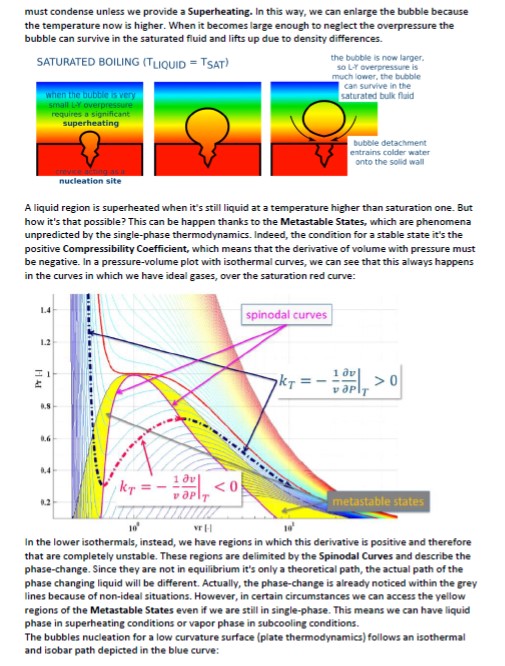


Descrizione
Focus
The course focuses on an advanced treatment of heat transfer, and it is aimed at solving problems of intermediate complexity mainly concerning the propulsion and the thermal control of space equipments and systems.
Detailed description of the topics
1. Heat conduction. Heat conductivity. The heat diffusion equation; initial-, boundary- and interface- conditions. Steady-state, one-dimensional solutions; thermal resistances and equivalent circuits; fin design. Transient conduction: lumped-capacity solutions, analytical solutions in one-dimensional slab, one-term approximation; analytical solutions in a semi-infinite medium with constant or periodic temperature boundary condition; thermal waves; the Duhamel theorem. Introduction to steady and transient multidimensional conduction by means of numerical methods, explicit and implicit schemes, direct and iterative solving methods.
2. Convective heat transfer. The governing equations. Forced convection in external flows: heat transfer for a laminar flow over a flat surface, the integral method; turbulent boundary layers, micro- and macro- scales, velocity profile; some relevant heat transfer correlations for flows over flat plate, cylinders, spheres and bluff bodies. Forced convection inside ducts: the bulk temperature, the fully developed region and the Graetz problem; the most relevant dimensionless correlations for the friction factor and for the heat transfer coefficient; the logarithmic mean temperature difference. Natural convection. Introduction to boiling and condensation: evaporation, pool boiling, the boiling curve, critical heat flux and minimum heat flux; forced-convection boling inside tubes; film condensation on a vertical plate and inside tubes.
3. Radiative transfer. Thermal radiation, radiation intensity, characteristic spectral and total radiation amounts. Blackbody radiation: Planck distribution, Stefan-Boltzmann law, Wien displacement law, band emission. Surface emission, absorption, reflection and transmission; Kirchhoff law; grey surface and selective surface. Solar and environmental radiation, radiators, the greenhouse effect. Radiation exchange between grey surfaces: view factors and their relationships, evaluating radiation exchange between gray surfaces in an enclosure. Volumetric absorption, gaseous emission and absorption.
4. Thermal analysis. Introduction to thermal control: operative and survival limits; internal and external thermal sources, heat sinks; cooling/ insulating devices for electronic/space equipments: fillers, thermal bridges, cold plates, heat pipes, Peltier cells, coatings and clothings, primary and secondary surface mirrors, space radiators.
5. Thermal modeling. Lumped-capacity approach: arithmetic and diffusive nodes, mesh types, thermal resistances (conductive, contact, convective, radiative); introduction to numerical codes to solve thermal equivalent circuits for space applications. Numerical methods: finite difference approximation; introduction to a FEM numerical code; ray-tracing and Montecarlo methods for evaluating radiation exchange factors.
-
DispenseUniversitarieARCHITETTURA E DESIGN · APPUNTI
Payload Design
Politecnico di Milano · Docente Mauro Massari · 134 pagine
10,00€ Aggiungi al carrello -
DispenseUniversitarieDISPENSE · APPUNTI
Launch Systems
Politecnico di Milano · Docente Filippo Maggi · 161 pagine
10,00€ Aggiungi al carrello -
DispenseUniversitarieDISPENSE · APPUNTI
Satellite Communication and Positioning System
Politecnico di Milano · Docente Lorenzo Luini · 125 pagine
10,00€ Aggiungi al carrello -
DispenseUniversitarieINGEGNERIA AEROSPAZIALE · APPUNTI
Space Propulsion
Politecnico di Milano · Docente Filippo Maggi · 155 pagine
10,00€ Aggiungi al carrello
Recensioni
Ancora non ci sono recensioni.